Why most small businesses should start with a $20 automation before building an AI agent
September 9, 2026 · 4 min read · Brad Coulter
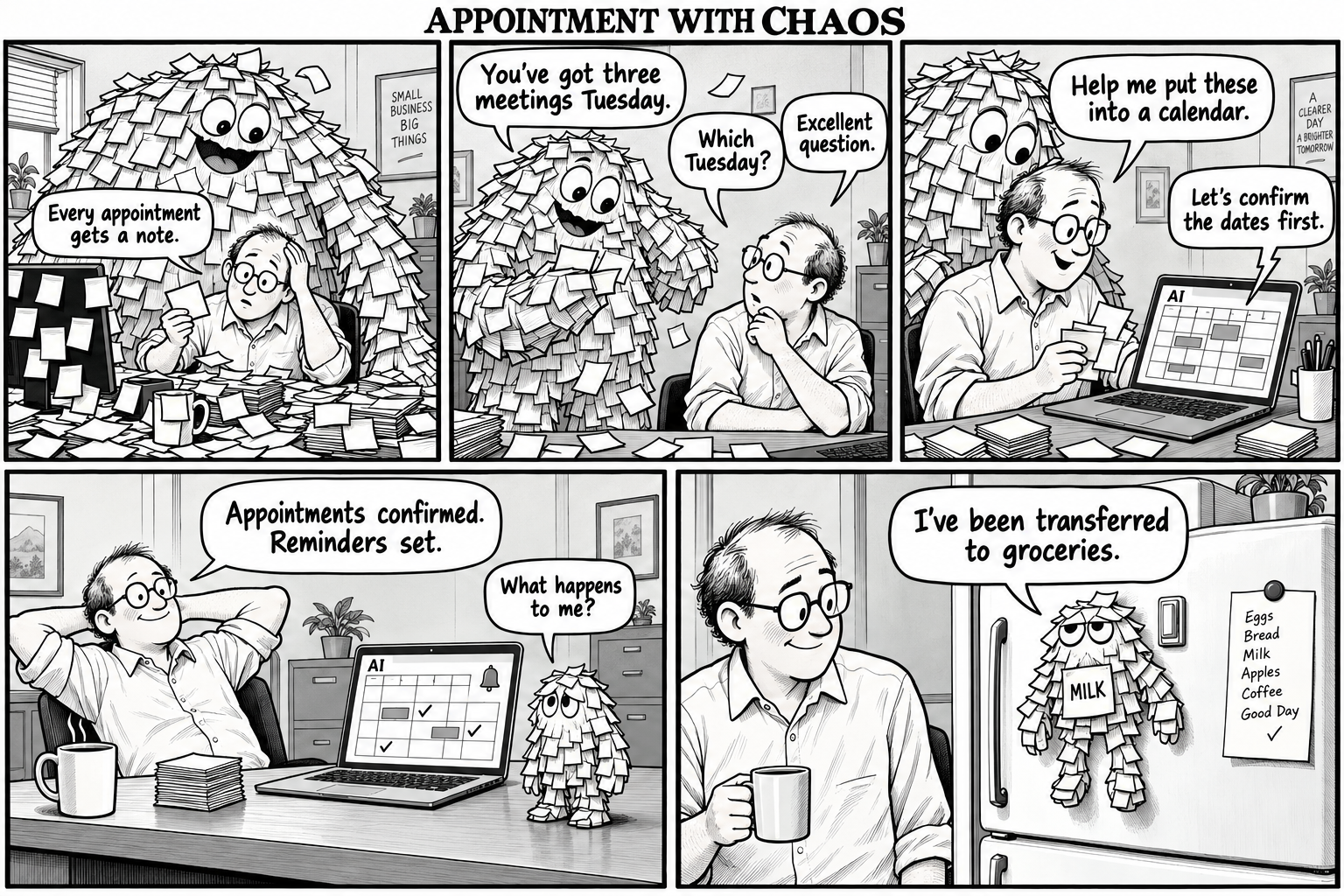
Every Monday for years, I rebuilt the same report by hand. Which invoices were past thirty days, which were past sixty, who I needed to call. The numbers were all sitting in our ticketing system and in QuickBooks. They just weren't sitting in the same place, so somebody had to carry them across. That somebody was me, and it was the first hour of every week.
I run a repair shop in Berlin, New Jersey, with my son. I have for twenty years. When people ask me about AI, this is usually where the conversation goes: they've read about agents, they want one to answer the phone or handle the inbox, and when I ask what they actually do by hand all week, they describe something like my Monday report. Copying the appointment out of the email into the calendar. Typing the same customer into the invoicing program that's already in the booking program. Texting the crew what the schedule says.
Same information. Different boxes. Three times a day.
That is not an AI problem. That is a plumbing problem, and plumbing is cheap.
The boring answer usually wins
Here's what I've learned shipping real systems, mine and other people's: most of the value comes from connecting the things you already use, not from adding something new.
An AI agent is software that can read messy input, make a judgment call, and take an action on your behalf. It's genuinely useful. But it sits on top of your existing systems, and if those systems don't talk to each other, the agent becomes one more thing that doesn't talk to the other things. My Monday report didn't need anything smart. It needed the ticketing system and the books to be read by the same screen. Now they are, and the report is just there when I sit down.
What actually needs intelligence
There's a simple test. If you do the same steps in the same order every time, you don't need AI. You need automation.
Automation is for the repetitive stuff:
- When a form comes in, put it on the calendar
- When a payment lands, send the receipt and update the sheet
- Every Monday at nine, send the week's schedule to the crew
AI is for the messy stuff:
- Reading an email that might be a quote request, a complaint or a question, and deciding which
- Working out whether a new appointment collides with a job that's already booked
- Pulling up what a customer said last time, when they call back
Twenty years of listening to people describe what's wrong taught me the pattern. They imagine they need the intelligent thing. Most of the pain is the repetitive thing.
The real cost isn't the software
The automation platforms, Zapier, Make and the like, charge twenty or thirty dollars a month for enough connections to run most of a small business's routine. That isn't the expensive part.
The expensive part is figuring out which of your nine tools actually has to talk to which three. It's discovering that the form you've used for two years never asked how the customer wants to be contacted, so nothing downstream can send the confirmation the way they'd want it. That's not a technology problem. It's a sit-down-and-map-the-week problem, and it is most of the work.
When you actually need the AI part
I do build AI into workflows. It goes in specific spots.
At my own shop, twelve years of repair tickets had a category field that was filled in through 2019 and almost never after. Twenty thousand work orders, and I couldn't tell you with a straight face how many were phones and how many were game consoles. Nothing repetitive fixes that. Somebody, or something, has to read each ticket and decide what it was. That reading step is the AI. Everything around it, pulling the tickets, writing the answer back, running it again on the new ones, is ordinary plumbing.
That's usually the shape. Intelligence at the one decision point. Plumbing everywhere else.
Start where it hurts most
If you're reading this because you think AI might help your business, here's what I'd suggest.
Write down the three things you do most often that feel like a waste of time. Not the hard problems. The annoying ones. The "why am I typing this again" ones. Most of the time those are automation problems, and you don't need AI to solve them. You need your tools to talk to each other.
If you want a second pair of eyes, the assessment on this site is free. Answer a few questions about how your business actually runs and I'll send you a written plan: what's worth automating, what isn't, and what I'd do first. Take it and run with it yourself if you like. And if there's nothing in your business worth automating, I'll tell you that too.
But start with the boring stuff. That's where the money usually is.
Written by
Brad Coulter
Forty years fixing technology for people. Twenty of them in a repair shop in South Jersey. More about me
Sounds like your week? Tell me what's eating it. The written assessment is free, and if there's nothing worth automating, I'll say so.