Why We Don't Build AI Agents First
September 15, 2026 · 4 min read · Brad Coulter
The temptation, when a business comes to us with something repetitive eating up staff time, is to talk about building a custom agent to handle it. Natural language processing, decision trees, the works.
Here is how that usually goes, across this whole industry: three weeks of building, a handover, and then it sits unused because nobody on the team knows how to feed it data or what to do when it gives a weird answer.
The AI works fine. The business just isn't ready for it.
The thing nobody mentions about AI agents
An AI agent is only as useful as the system around it. If your team is still copying data between a spreadsheet and an email and a PDF, the agent becomes one more place data has to go. If nobody has a clear process for what happens when the agent flags something, it just creates a new pile of things to ignore.
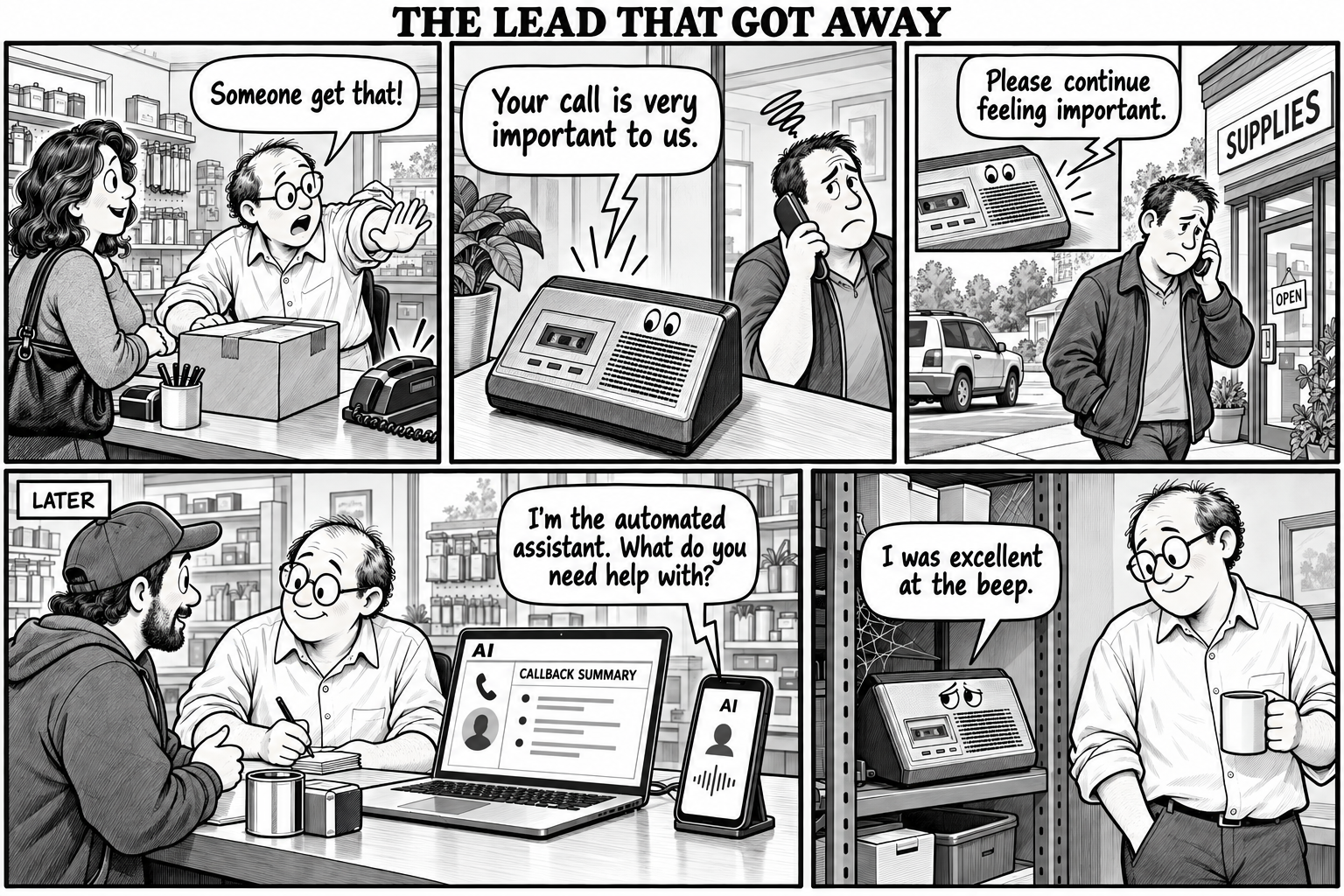
Picture a service business in Camden County that wants an agent to triage incoming requests and route them to the right person. Reasonable idea. Say it gets built, and it works. But the intake process is scattered across three email addresses, a contact form that doesn't send notifications reliably, and a voicemail box two people share.
The agent can't fix that. It just adds a fourth thing to check.
What actually works: fix the plumbing first
We start every engagement the same way — we map where information moves in the business. Not where it's supposed to move according to some diagram from five years ago, but where it actually goes. Who emails who, what gets printed, what lives in someone's head.
Nine times out of ten, the highest-value work in a small business is connecting two systems that were never talking to each other. A form that writes directly to a spreadsheet. A spreadsheet that triggers an email when a row changes. An email that logs itself in a CRM without anyone clicking anything.
This is automation, not AI — and it's almost always what a business needs first.
Here's the shape of it. Say a 30-person business is manually copying appointment requests from a web form into a scheduling system, then sending a confirmation email, then updating a spreadsheet the manager checks every morning. Call it 20 minutes per appointment. Fifteen appointments a day means someone spends five hours a week on pure data transfer.
The fix is a chain: form submission → writes to the scheduling tool → sends a templated confirmation email → updates the tracking sheet. No AI, no agent, no ongoing per-transaction cost. That is an afternoon of setup, and it runs until something upstream changes.
Set against roughly 260 hours a year, even at $15 an hour, a job like that pays for itself several times over in the first year.
When an AI agent actually makes sense
Once the basics are connected — once data flows predictably and the team has a process they trust — then an AI agent starts to make sense. Because now you're asking it to do something well-defined with clean inputs.
Now suppose that same business, six months on. Appointments flow cleanly into the system, and they want help drafting follow-up messages based on appointment notes. That's a good fit for AI: predictable input, clear task, human review before it goes out.
A simple agent reads the appointment note and suggests three follow-up messages in the office's voice. Staff picks one, edits it if needed, sends it. That's a Build — one workflow, specified in writing first — and it works because the plumbing was already there.
What this means if you're thinking about AI
If your business is still doing a lot of manual copying, forwarding, reminding, or checking — that's not an AI problem. That's a plumbing problem, and it's almost always cheaper and faster to fix.
Start with the $20-a-month automation that connects two systems you already use. See if your team actually uses it. See where it breaks. Fix that. Then see what's still taking up time.
If after all that you still have a repetitive decision-making task that needs judgment but not creativity — approving requests, triaging inquiries, drafting responses — that's when you're ready to talk about an agent.
How we work now
We start every engagement with a free assessment: a short form about how your business actually runs, a twenty-minute call, and one written page back — what we saw, what's worth doing first, and what it would cost. That page is yours. Build it yourself, hire someone else, or come back to us.
If you come back, the first step is usually a First Fix: one thing from that page, set up with you in a week, every step written down, for $1,500 fixed. When the thing has to be wired into your books or your phone system, that's a Build — one workflow, specified in writing before a line of code, from $6,000. The numbers are on the website.
We're not trying to sell you the fanciest solution. We're trying to sell you the one that'll actually get used.
Written by
Brad Coulter
Forty years fixing technology for people. Twenty of them in a repair shop in South Jersey. More about me
Sounds like your week? Tell me what's eating it. The written assessment is free, and if there's nothing worth automating, I'll say so.